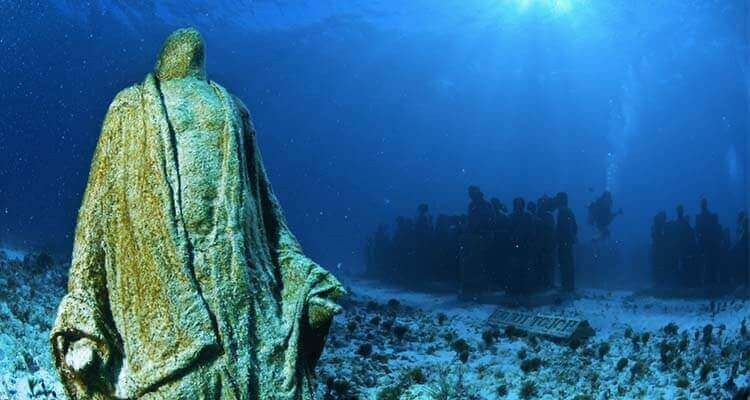
Cancun has more dive sites than most people realize. The reef system stretching from the hotel zone toward Isla Mujeres offers everything from shallow beginner dives to deep wreck dives, and the Yucatan Peninsula adds cenote diving to the mix. If you’re planning a dive trip from Cancun, here’s an honest local guide to what’s actually worth your time — organized by experience level and what you’re looking for.
MUSA & Manchones Reef — Best for Beginners and First-Timers
If you’re newly certified or trying diving for the first time, MUSA and Manchones Reef are where you want to be. Both sites are shallow, calm, and full of marine life — and we cover both on the same trip.
MUSA — Museo Subacuático de Arte
MUSA is the most iconic dive site in Cancun and one of the most unique in the world. More than 400 life-size sculptures sit on the ocean floor at 10 meters (30 feet), now covered in coral and surrounded by reef fish, sea turtles, lobsters, and angelfish. The shallow depth and calm conditions in the bay make it ideal for beginners and newly certified divers, while the sheer spectacle makes it worth diving for experienced divers too.
No certification? You can still dive MUSA on a Discovery Dive with one of our instructors—read everything you need to know here.
Manchones Reef
Manchones is one of the longest reefs in the area — a natural coral reef teeming with marine life at similar depths to MUSA. On a calm day the visibility is exceptional and the reef is full of color. We combine Manchones with MUSA on the same trip, giving you two completely different underwater environments in one morning.
Best for: Beginners, Discovery Divers, newly certified Open Water divers Depth: 10 meters / 30 feet Certification: Open Water or none Discovery Dive available
Wrecks & Reefs — Best for Experienced Divers
If you’re Advanced Open Water certified and want a more challenging dive, Cancun’s wrecks are the highlight of the area.
C55 & C58 — Navy Wrecks
Two decommissioned Mexican Navy vessels deliberately sunk to create artificial reefs at 84 feet (25 meters). Both wrecks are now covered in coral and home to sea turtles, barracudas, large groupers, moray eels, and during winter months, spotted eagle rays. The depth requires Advanced Open Water certification — but it’s one of the most rewarding dives you’ll do in the Mexican Caribbean.
Herradura, Gampin & Aristos Reefs
After the wreck we head to one of the natural reefs in the area at approximately 65 feet (20 meters). Each reef has its own character — coral formations, open reef landscapes, and abundant fish life that contrasts nicely with the structure of the wreck.
Double Reef Option
Not yet Advanced certified but want more than a beginner dive? Our Double Reef trip</a> covers two different reef sites in one afternoon — suitable for Open Water certified divers.
Best for: Advanced Open Water certified divers Depth: 84 feet wreck / 65 feet reef Certification: Advanced Open Water required for wreck, Open Water for double reef Book: Cancun Wreck & Reef Dive
Cenote Diving — A Completely Different Experience
Cenote diving is unlike anything you’ll find in the ocean. The Yucatan Peninsula sits on top of one of the largest underground river systems in the world, and cenotes — natural sinkholes filled with crystal clear freshwater — give you access to this hidden network of caverns.
Dos Ojos
Our primary cenote destination is Dos Ojos, approximately 1.5 hours from Cancun. Named after its two connected cavern openings, Dos Ojos has some of the best visibility of any dive site anywhere — often exceeding 100 meters. We dive the cavern zone where natural light filters through, creating light effects you won’t forget. Two dives, private trips only.
Best for: Open Water certified divers looking for something completely different Depth: 45 feet / 14 meters average Certification: Open Water required, no cave certification needed Book: Private Cenote Dive at Dos Ojos
Seasonal & Specialty Dives
Whale Sharks — June to September
If you’re visiting Cancun between June and September, don’t miss the chance to swim with whale sharks near Isla Mujeres — the world’s largest fish gather here seasonally and it’s one of the most unforgettable ocean experiences you can combine with your dive trip.
Book: Whale Shark Snorkel Tour
Manta Valley — October Only
During October, manta rays gather at a site we call Manta Valley in unusually high numbers. This is an advanced dive available on private trips only — Advanced Open Water and nitrox certification required. If you’re a qualified advanced diver in Cancun during October, contact us directly about this trip.
Should You Take a Day Trip to Cozumel from Cancun?
This comes up a lot and the honest answer is: probably not. Cozumel is one of the best dive destinations in the world — but getting there from Cancun is a serious commitment. The trip involves an early departure around 5:00 AM, a bus transfer to Playa del Carmen, a ferry crossing, the dives, and the return journey — putting you back in Cancun around 7:00 PM. That’s a 14-hour day with 3 to 4 hours of commuting for two dives.
If you’re staying in Cancun for a week and have a full free day, it can be worth it. If you’re short on time, Cancun’s own dive sites offer more than enough without the logistics.
If you specifically want to dive Cozumel, stay in Cozumel.
Which Dive Is Right for You?
- No certification → Discovery Dive at MUSA
- Open Water certified, first time in Cancun → MUSA & Manchones Reef Dive
- Open Water certified, want two reefs → Double Reef Dive
- Advanced Open Water certified → Wreck & Reef Dive
- Want something completely different → Cenote Dive at Dos Ojos
- June to September → Whale Shark Snorkel Tour
- October, Advanced + Nitrox certified → Contact us about Manta Valley